Tree Triptych - When contrast became part of the design
Some pieces begin with a clear plan. Others find their final character somewhere along the way.
Tree Triptych belongs to the second kind.
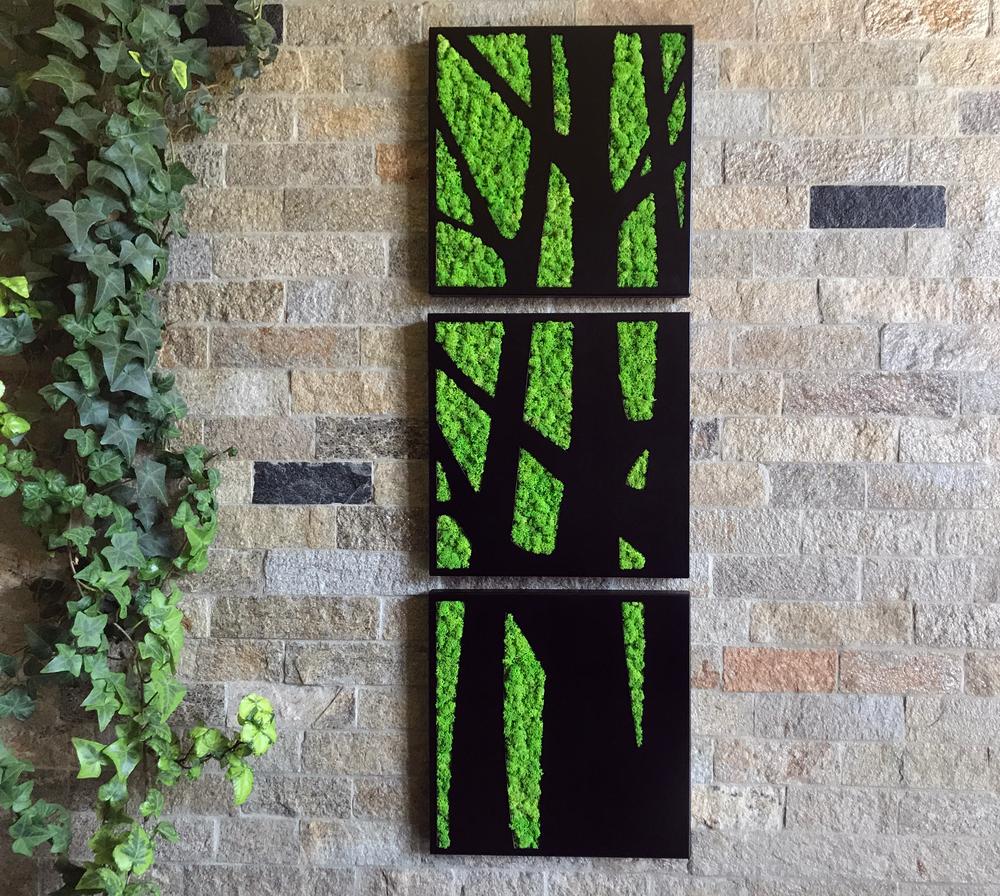
Created during the early years of MossArtum, the piece consists of three 30 × 30 cm panels that together form a single stylised tree. Its trunk and branches continue from one panel to the next, while the spaces between them become part of the composition itself.
The design was created by our friend and graphic designer Asena, with whom we collaborated closely during those early years. Many of our first pieces began with her drawings and ideas, which we then translated into wood, texture and three-dimensional form.
When the material changed the idea
The three panels were made from linden wood.
Our original intention was to keep the character of the timber visible, so we finished the wood with coloured oil. But once the preserved moss was added, something did not feel right.
The colour of the wood was not dark enough.
Instead of defining the composition, the silhouette of the tree began to disappear beside the vivid green moss. The moss was visually stronger than everything around it.
So we made a decision that initially felt almost like a compromise: we painted the wood completely black.
The natural texture of the linden became less visible — something we would normally be reluctant to lose.
But something else appeared in its place.
The tree suddenly became a strong graphic silhouette.
The deep black surface created a sharp contrast with the organic texture of the moss, and the entire composition became simpler, clearer and much more powerful.
What began as a correction became one of the defining features of the piece.
Three panels. One tree.
There is another element we particularly like about this design.
The three squares are separate objects, yet the tree does not respect their boundaries. Its branches continue visually across the gaps, allowing the empty spaces between the panels to become part of the artwork.
The result sits somewhere between wall art, graphic composition and a small architectural installation.
Black gives it structure.
Moss gives it life.
And the tension between the two is what makes the piece work.
An early MossArtum piece
Tree Triptych was created at a time when we were still discovering what MossArtum could become.
We were experimenting with wood, preserved moss, colour and relief — learning how one material could completely change the way another was perceived.
Soon after we showed the finished piece, it found its home.
Looking at it today, we can recognise something in it that has remained with us ever since: a fascination with natural materials, strong silhouettes, negative space and the dialogue between controlled geometry and organic texture.
The techniques have evolved.
The work has become more complex.
But some of the ideas were already there.
Available as a Made-to-Order Commission
The original Tree Triptych has been sold, but the design can be created again as a made-to-order artwork.
The original composition consists of:
3 individual panels · 30 × 30 cm each. Linden wood · preserved moss · hand-finished surface
A new Tree Triptych can be created close to the original design, or its dimensions and proportions can be adapted to a particular wall and interior.
Because every piece is made individually and preserved moss is a natural material, each new version will have its own subtle variations in texture and character.
- Dimensions
- 3 individual panels · 30 × 30 cm each
- Materials
- Linden wood, preserved moss
- Estimated production time
- 1-2 weeks
- Price
- €390
The artist's note
Inspiration
This piece takes us back to the early days of MossArtum, when we were still discovering how wood and moss could speak to each other.
We originally wanted to preserve the natural character of the linden wood, but the piece had other plans. Painting it black felt like a risky decision at the time — yet the moment we did, the tree came alive.
We lost the visible grain, but found the contrast the composition needed.
Perhaps that is why we still feel so connected to this piece. It taught us something we have carried into our work ever since: sometimes the material leads you somewhere better than the original plan.
— Victoria&Boris, MossArtum