
August 13, 2026
Phoenix Within
When an Artwork Teaches Its Creators
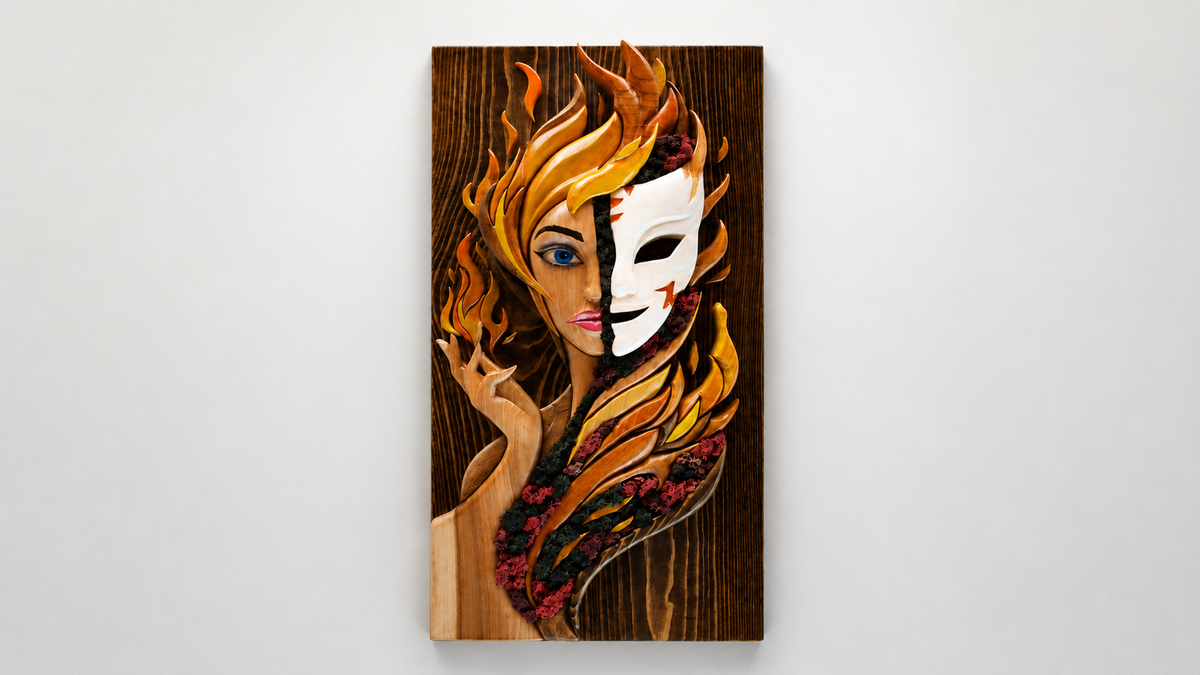
Every commissioned artwork begins with a conversation.
This one began with a request from a close family of friends who were looking for an extraordinary graduation gift. Their friends' daughter was about to finish school, and they wanted to give her something that could never be bought off a shelf.
As they described her, a picture slowly began to form.
She was deeply artistic. She performed in a troupe that danced with fire, walked on stilts, and studied acting. She had already seen some of our earlier works and had fallen in love with the combination of hand carving and preserved moss.
Those few details were enough to tell us one thing: this could not become a generic decorative artwork. It had to become a portrait of a personality.
Looking for the Right Story
Victoria and I spent days discussing one question.
How do you combine fire dancing, theatre and stilt walking into a single elegant composition?
Every idea seemed to capture only part of her character.
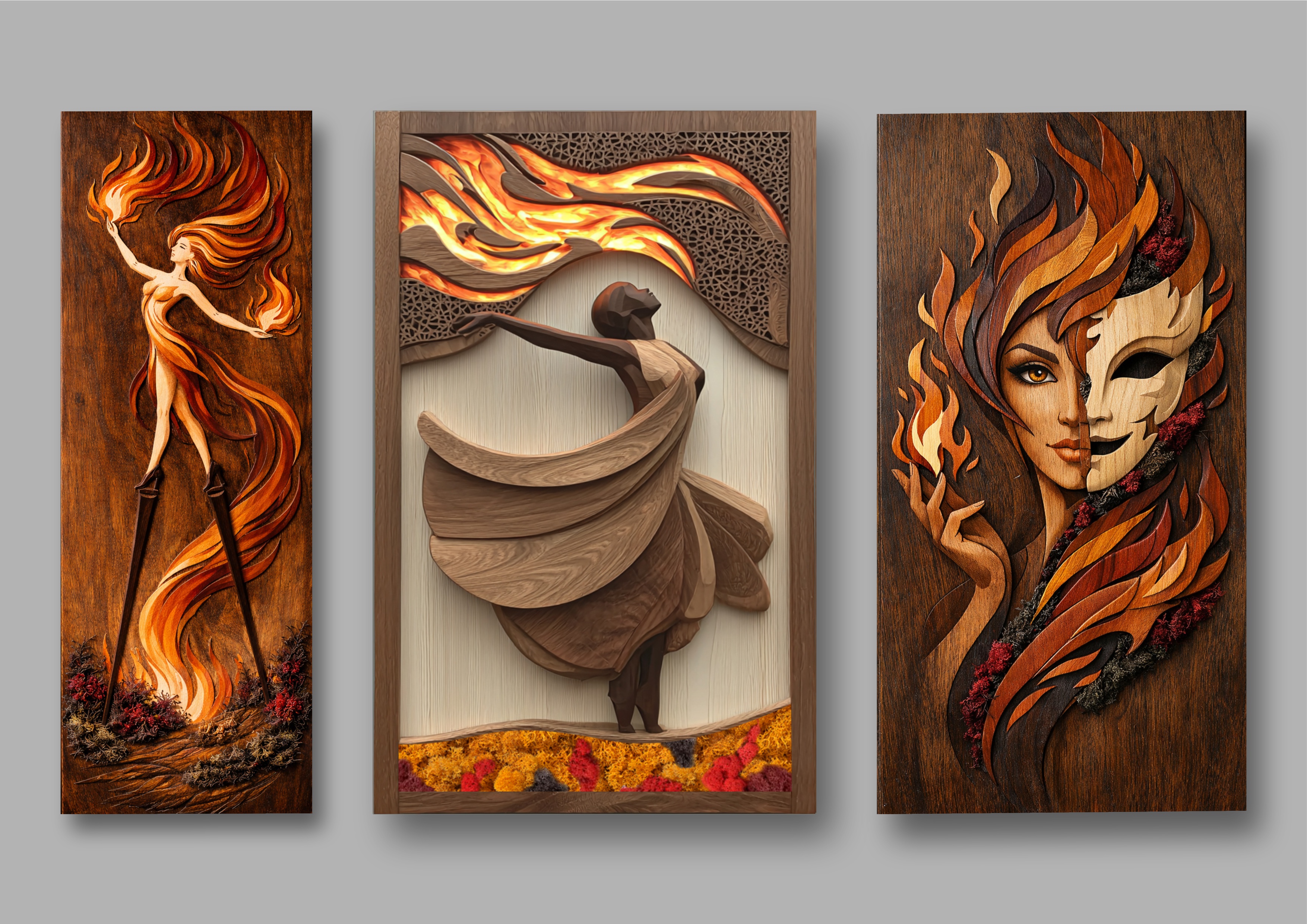
Eventually we stopped trying to force all three into one design and created three completely different concepts instead.
One of them showed a fire dancer on stilts—a design I personally loved. Another explored a different interpretation of movement and performance. The third focused less on what she did and more on who she seemed to be.
Rather than making the decision ourselves, we presented all three designs to the family.
They gathered together and voted.
To our surprise, the discussion on their side became almost as passionate as ours had been. Every design had its supporters, and choosing only one proved far more difficult than anyone expected.
After many conversations, one concept finally emerged as the favourite.
Before the carving began, one more request arrived from the family.
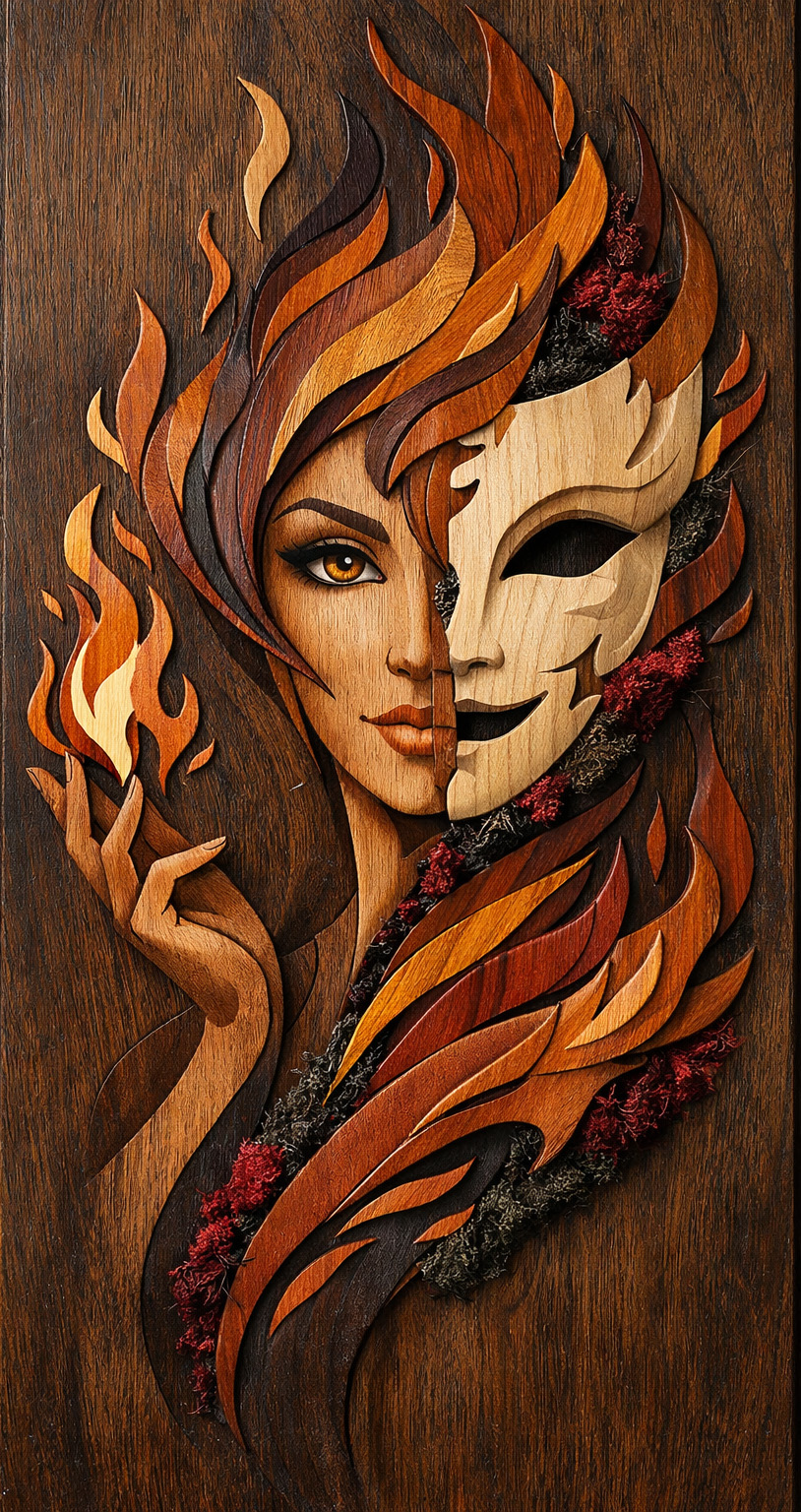
When we created the three concept drawings, the portraits were intentionally generic, designed only to express the overall idea.
Once the final concept had been chosen, the family asked whether we could make it even more personal.
She had blue eyes.
Fair hair.
Could those details become part of the artwork?
We never prepared a new design.
Instead, those changes quietly found their way into the carving itself.
Somewhere between the drawing and the finished sculpture, the portrait slowly stopped being an imaginary character and became hers.
Only then did the real challenge begin.
"How Are We Going to Build This?"
Once the final design had been approved, we looked at it in silence.
Then one of us finally asked the obvious question:
"How are we actually going to make this?"
While designing the artwork, we had become so absorbed in creating something beautiful that we had barely thought about the technical reality waiting on the other side.
And suddenly it became very clear.
This piece required things we had never attempted before.
A realistic female face.
An anatomically convincing human hand.
Layered sculptural flames.
Every one of them represented unexplored territory.
Beginning with the Hardest Part
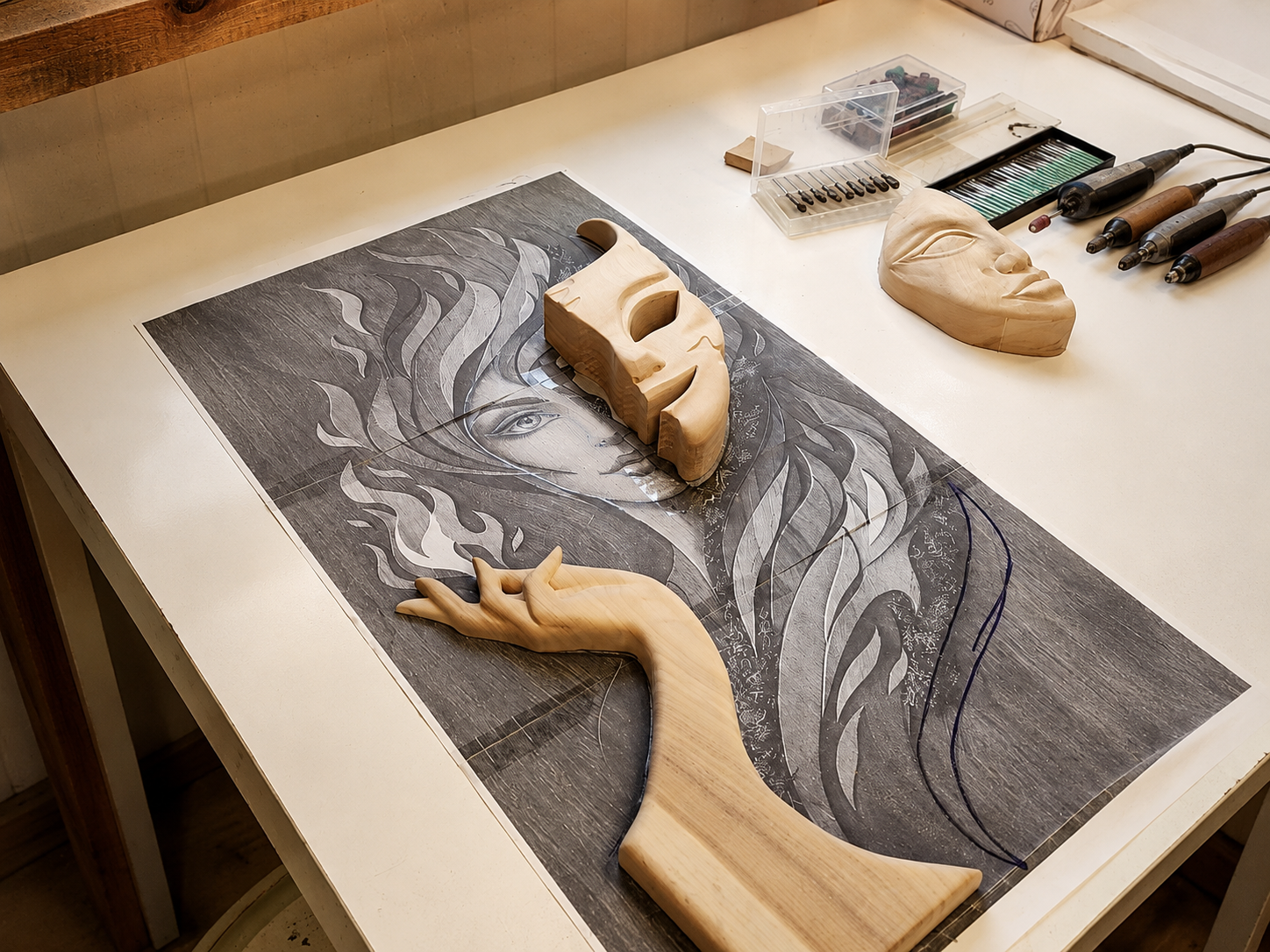
We decided to begin with the most intimidating element.
The face.
If the face failed, nothing else would matter.
I prepared several pieces of limewood for Victoria. Its fine grain and light colour make it one of the most forgiving woods for detailed carving, and I suspected she would need more than one attempt.
I was right.
Until then, Victoria had never carved a realistic human face.
Very quickly we discovered that every feature brought its own lesson.
The nose could look correct from the front while becoming completely wrong in profile.
The lips had the same problem.
The eye seemed simple—until it suddenly looked too prominent, too narrow, too slanted or unexpectedly cat-like depending on the angle.
It was no longer a matter of carving individual details.
She had to learn to think in three dimensions.
For nearly a week, the workshop became a classroom.
She practised noses.
Eyes.
Lips.
Then entire faces.
Only after each individual element began to work on its own could they finally be combined into one harmonious sculpture.
There was even a moment when we seriously considered having the face machined on a CNC router.
Living in a small town has many advantages.
Finding someone capable of producing such specialised work is not one of them.
So we returned to the workbench.
Victoria simply kept carving.
Eventually, the face appeared.
Giving Her Expression
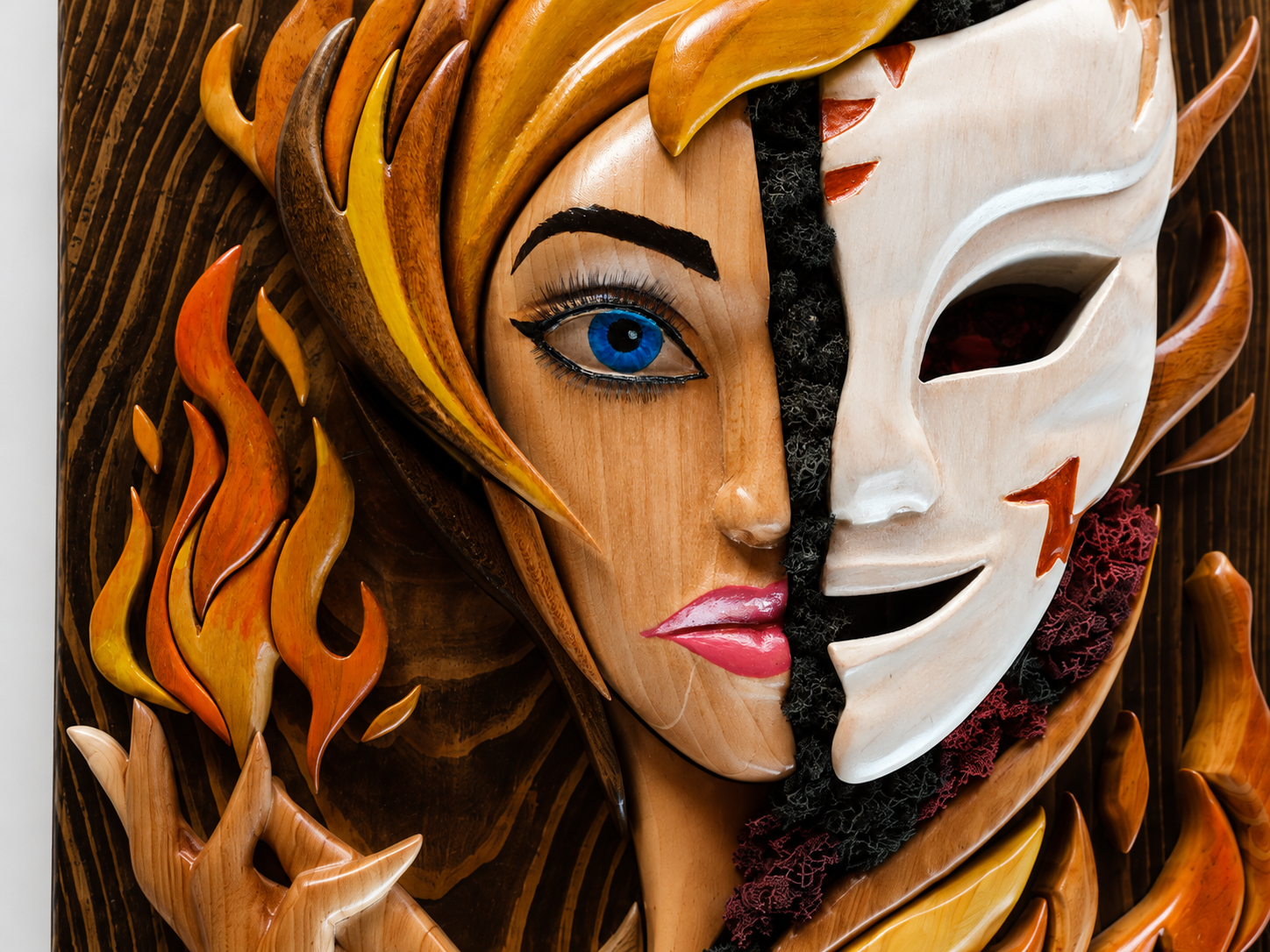
Once the carving was complete, another unexpected challenge appeared.
The face needed life.
That meant learning techniques we had never used before.
Subtle colouring.
Soft shading.
Even eyelashes.
Ironically, Victoria had almost no personal experience with makeup, yet suddenly we found ourselves studying how tiny cosmetic details influence expression.
Somewhere during that process the sculpture quietly stopped looking like wood.
It started looking back.
The Other Face
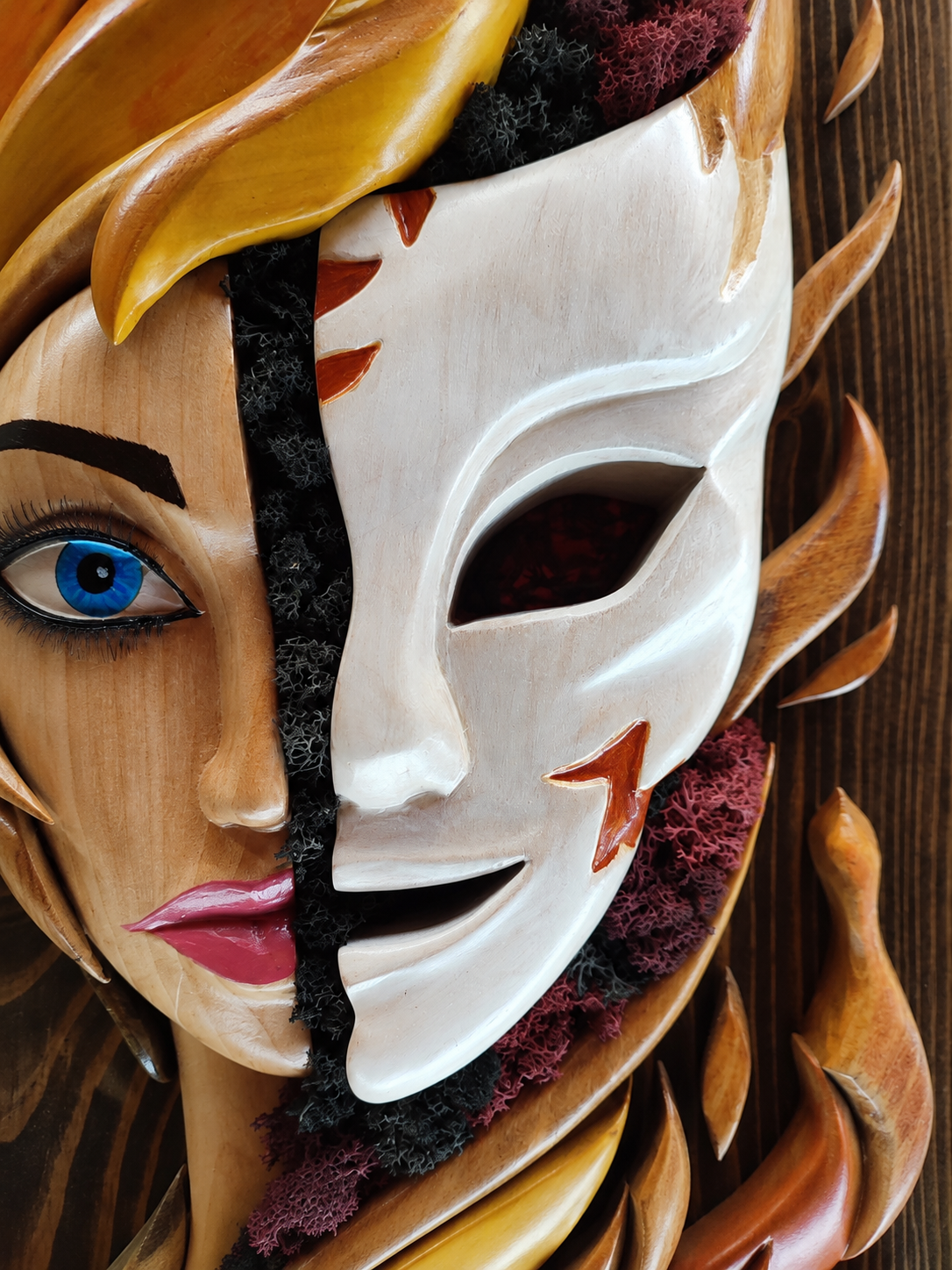
Compared to the portrait, the theatrical mask felt almost relaxing.
Originally it existed simply as a reference to acting.
But while working on the composition, another meaning slowly emerged.
The beautiful face and the mask no longer represented two separate characters.
They became two sides of the same person.
The part of ourselves we willingly show the world.
And the part we quietly struggle with inside.
That is why the mask carries a small horn—subtle enough that many people never notice it at first glance.
Not as a dramatic symbol of evil.
Only as a quiet reminder that every person carries both light and shadow, and every day we choose which one will shape us.
Building Fire
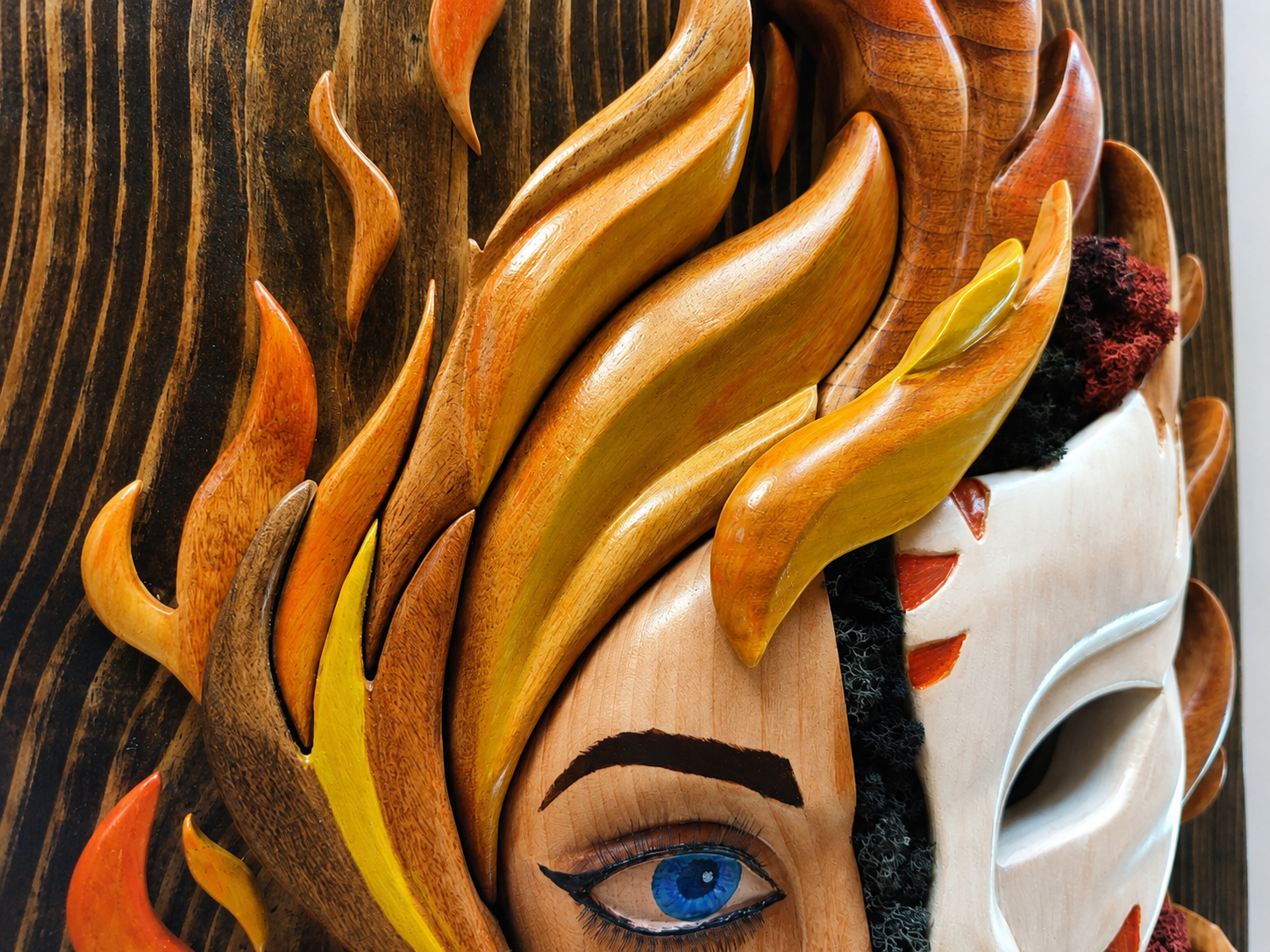
The flames brought a completely different kind of challenge.
Carving them was not difficult.
Attaching dozens of individually carved pieces onto the three-dimensional forms of the head and mask without losing elegance—that was the real puzzle.
Eventually we found a solution.
To make the fire feel alive, we deliberately used different species of wood, allowing their natural colours and grain to become part of the flames themselves.
The fire was never painted.
It was already hidden inside the wood.
The Final Piece
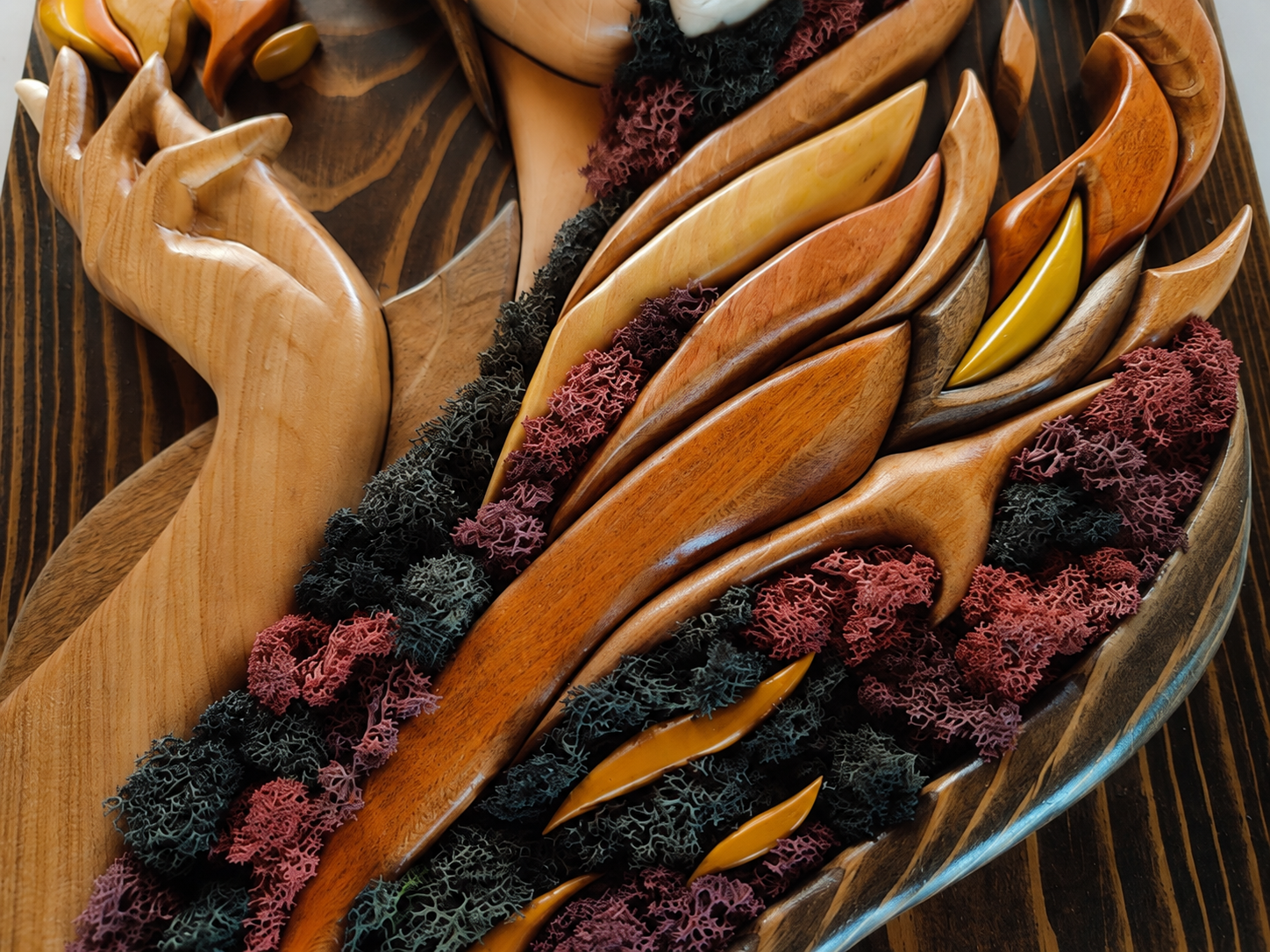
The final step was choosing the preserved moss.
The family had told us how much she admired that combination in our previous works, so incorporating moss into the composition felt like completing a promise we had made at the very beginning.
When everything finally came together, the artwork had become something far more dimensional than we had imagined when we first sketched it.
A Surprise We Never Expected
We were not present when the gift was given.
Later, the family told us what had happened.
She was deeply surprised — not only by the artwork itself, but even more when she learned it had been designed specifically to reflect her personality.
As she looked at it, she suddenly began to recognise something familiar.
The carved face reminded her of her own.
Smiling, she held the artwork beside her face and took a photograph to compare the two.
We have never asked permission to publish that picture, so it remains a private memory.
Some moments belong only to the people who lived them.
Why "Phoenix Within"
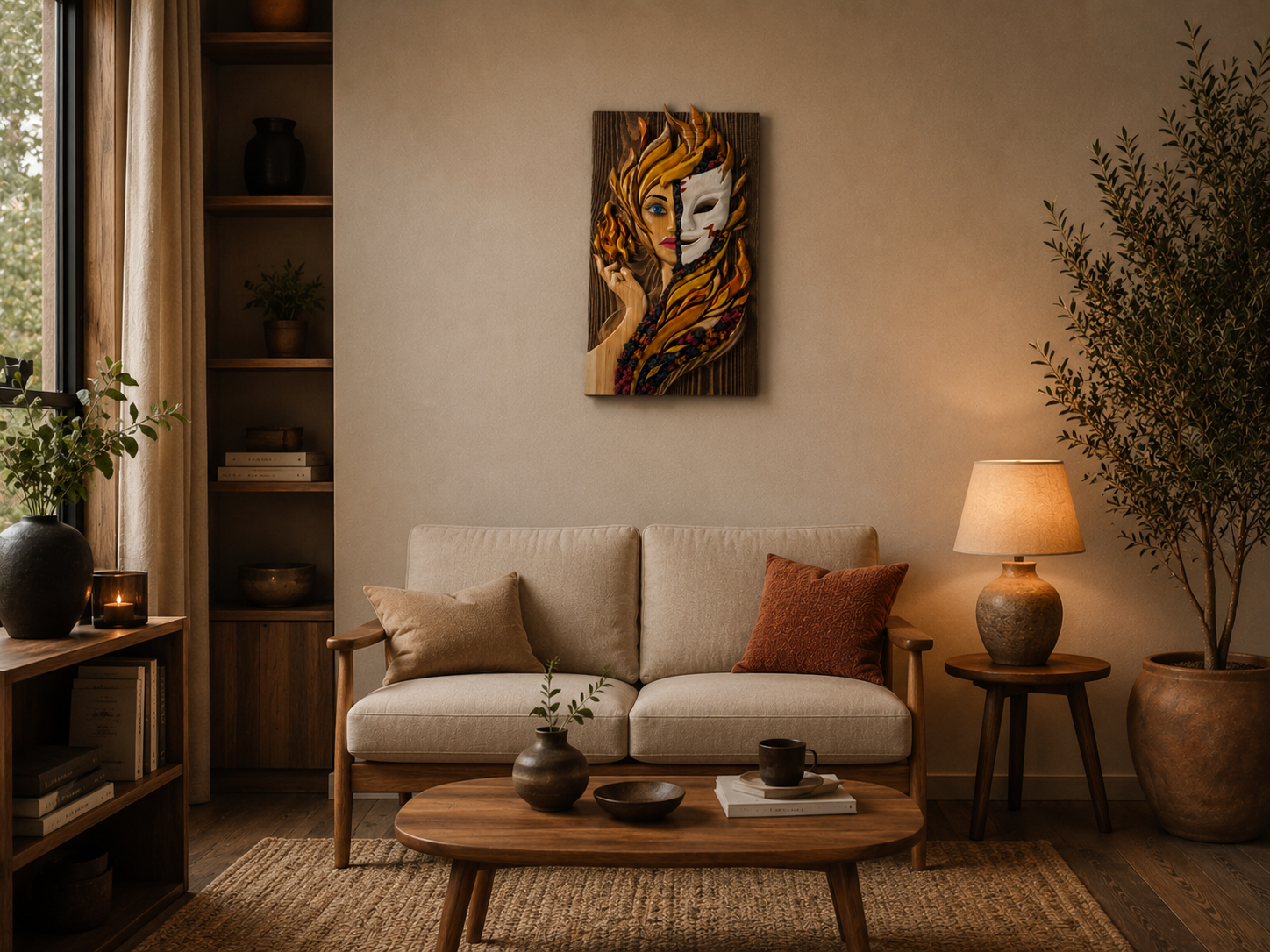
Curiously, the artwork had no title while we were creating it.
The name came only after everything had been finished.
Looking back, it seemed inevitable.
The fire.
The courage to begin a new chapter in life.
The quiet transformation that every young person experiences while stepping into adulthood.
And perhaps something else as well.
During the making of this piece, it was not only the artwork that changed.
We changed too.
Every failed attempt, every corrected detail and every new technique forced us to become better craftsmen than we had been only weeks before.
In that sense, Phoenix Within became more than the portrait of one remarkable young woman.
It also became a reminder that every meaningful work of art transforms its creators before it ever reaches the person it was made for.
After the Gift Was Given
*"I received this beautiful piece and I have to say the craftsmanship, finish and care with which it was created is unparalleled. The details are beautiful and hand-crafted in ways that highlight each part of the diptych to create a masterful and solid artwork. The team also took care to look into the philosophy behind the idea. Thank you to mossartum for all the hard-work and care!"
— Plamen, for whom Warrior Within was created*