August 22, 2026
What Is Wood Intarsia? A Guide to the Art of Wood Inlay
Wood intarsia transforms individually shaped pieces of natural wood into a single composition. Discover how the technique works and how contemporary relief intarsia differs from traditional marquetry and inlay.
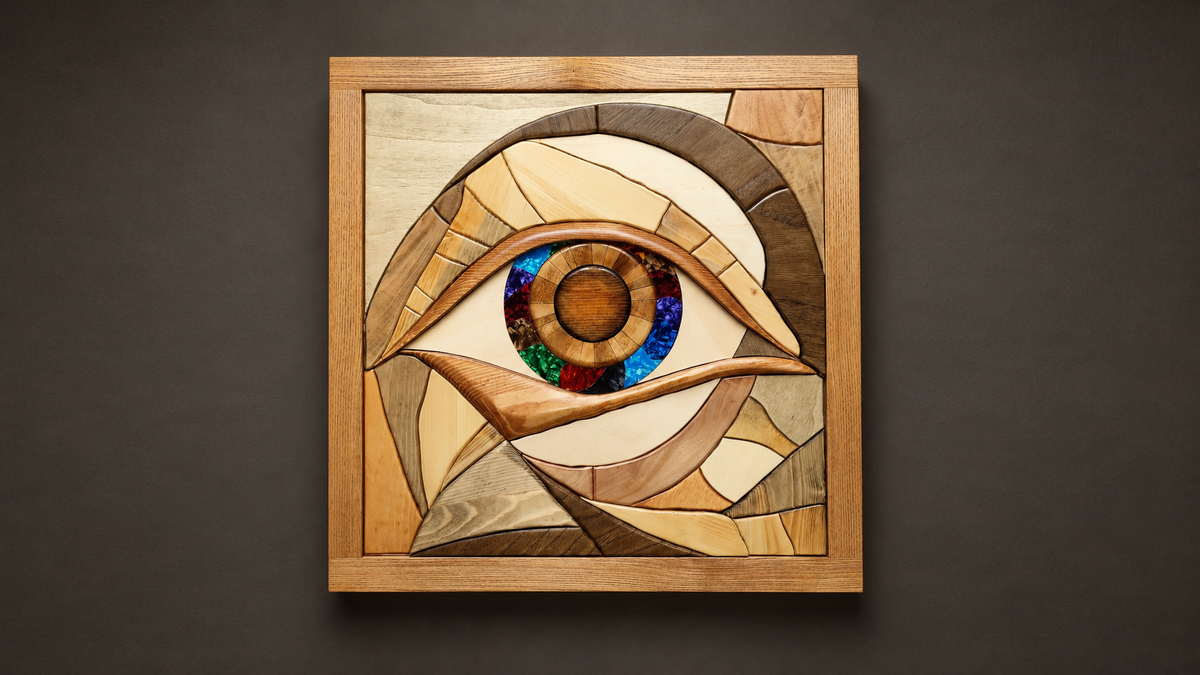
Wood has a remarkable ability to tell a story without being painted.
Its colour, grain, texture and natural variation can become part of an image — sometimes suggesting movement, depth or even emotion.
Wood intarsia is one of the techniques that makes this possible.
At its simplest, intarsia is the art of creating an image or composition by assembling individually shaped pieces of wood. Each piece is selected, cut and fitted as part of the larger design.
But there is more than one way to work with pieces of wood.
Intarsia is often confused with marquetry, wood inlay and relief carving. Although these techniques share some similarities, they create very different results.
Understanding the differences also helps explain what makes contemporary intarsia wall art different from a traditional decorative wood surface.
What Does “Intarsia” Mean?
The word intarsia has a long history in decorative arts.
Historically, it was used for highly detailed compositions made by fitting pieces of wood and other materials together to create pictures and ornamental designs. Some of the most remarkable examples were produced during the Italian Renaissance, particularly for furniture and architectural interiors.

Traditional intarsia can be remarkably precise. Different species of wood provide natural variations in colour and grain, allowing artists to create complex images without relying entirely on paint or artificial colour.
The fundamental principle remains simple:
An image is created from individual pieces of material rather than from a single surface.
Contemporary wood artists have expanded this principle in many different directions.
Some work with almost perfectly flat surfaces. Others shape, carve and layer the individual elements, turning the image into something more sculptural.
This latter approach is where our own work at MossArtum belongs.
Intarsia, Marquetry and Wood Inlay — What Is the Difference?
The terms are sometimes used interchangeably, but there are important differences.
Marquetry
Marquetry is traditionally made from thin sheets of veneer. The pieces are cut and assembled into a decorative skin, which is then glued onto a stable base such as furniture, a box or a panel.
The supporting surface beneath the veneer is not normally part of the image itself. The result is generally flat and smooth, even when the composition creates the illusion of volume.
Marquetry can be extraordinarily detailed. Because veneer is thin, artists can cut delicate lines, intricate patterns and subtle pictorial scenes that would be difficult to construct from thicker pieces.
The simplest distinction is:
Marquetry builds an image primarily from veneer. Contemporary intarsia builds it from individually shaped pieces of wood.
There are historical exceptions and areas of overlap, so these terms should not be treated as rigid boxes. Museums, historians and contemporary makers sometimes use them differently depending on period, region and construction method.

Wood Inlay
Wood Inlay is the broadest and most literal of these terms.
In an inlaid surface, a recess is cut into a base material and another material is inserted into it. The inserted element may be wood, metal, shell, stone, bone or another contrasting material. Once fitted and finished, it is often level with the surrounding surface.
A narrow brass line set into a tabletop is inlay. So is a mother-of-pearl detail inserted into wood. The technique does not necessarily create an entire image; it may be used for a border, symbol, small accent or decorative line.
Historical intarsia is itself often discussed as a form of wood inlay. The difference is one of emphasis: inlay describes the act of inserting one material into another, while intarsia usually refers to a more complex composition formed from multiple fitted pieces.
At MossArtum, small accents of mother-of-pearl, decorative glass or stone may sometimes function as inlaid details within a larger intarsia or carved composition.
 Inlay introduces a contrasting material into a recess cut into the surrounding surface
And What About Parquetry?
Parquetry is another relative in the same family, but its purpose is usually more geometric.
It uses repeated pieces of wood veneer or solid wood to form patterns such as diamonds, chevrons, cubes or stars. It is strongly associated with floors and furniture, although the same principle can be used in decorative panels.
Where pictorial marquetry may depict a flower, landscape or figure, parquetry usually relies on repetition and geometry.
Some MossArtum works—particularly those in the Geometry series—share parquetry’s interest in rhythm, repetition and contrasting wood. Their construction, however, is more sculptural: the wooden blocks project to different heights and create a relief rather than a flat patterned skin.

So, What Makes Intarsia Different?
In intarsia, the individual pieces themselves become the image.
Rather than placing a thin decorative layer onto a surface, each component can be shaped specifically for its position within the composition.
This opens up another possibility:
depth
A wing can be raised.
A leaf can curve.
A body can become rounded.
A transition between two pieces can be carved and softened.
The result can move beyond a flat decorative surface and become a sculptural artwork.
This is the approach we use in many MossArtum pieces.
Contemporary Relief Intarsia
Our work can be described as contemporary relief intarsia, often combined with hand carving.
The term is useful because it describes both the traditional foundation of the technique and the way we approach it today.
The individual wooden elements are:
- designed as part of the overall composition;
- cut separately;
- selected for their natural colour and grain;
- shaped and refined;
- assembled into the final image;
- and, where appropriate, carved or sculpted to create additional depth.
Instead of treating the wood as a flat substitute for paint, we allow the material itself to contribute to the character of the artwork.
From Digital Design to Finished Artwork
Every intarsia artwork begins with an idea.
For the Butterfly, the process started digitally before moving into the physical world.
The design was printed as a working template, transferred to wood, divided into individual elements and then gradually transformed into a finished composition.
Why Does the Grain Matter?
One of the most beautiful aspects of working with natural wood is that every piece already contains its own visual language.
The grain is never exactly the same.
Instead of hiding this variation, intarsia can use it as part of the composition.
The direction of the grain can follow the form of a wing. A darker species can create contrast around a lighter element. A naturally figured piece of wood can become a focal point without adding a single drop of paint.
This means that choosing the wood is part of designing the artwork.

Intarsia Can Be Flat — or Sculptural
There is no single visual style that defines contemporary intarsia.
Some artists create relatively flat compositions, where the pieces meet almost seamlessly.
Others introduce different levels and shapes, allowing individual elements to rise from the background.
This is where intarsia can begin to overlap with relief carving.
The difference is subtle but important.
In relief carving, the image is primarily created by carving into a continuous piece or surface of wood.
In relief intarsia, the image begins with separate pieces that are then shaped, assembled and sometimes carved further.
The two techniques can therefore work together.

Intarsia Is Also About Material Selection
There is no universal list of woods that must be used for intarsia.
Different species can be chosen for different reasons:
- natural colour;
- grain direction;
- figure and texture;
- hardness;
- workability;
- contrast with neighbouring pieces;
- or simply because a particular piece of wood has a character that belongs in the artwork.
At MossArtum, we often let the natural properties of the material influence the final design rather than forcing every element to conform to an artificial colour scheme.
This is one of the reasons why two versions of a similar design can still feel completely different.
From Pieces to a Whole
Perhaps the most fascinating part of intarsia is the transformation that happens during assembly.
Individually, the pieces may look almost abstract.
A single curved piece might appear to be nothing more than a shaped piece of wood.
Placed next to another, it begins to suggest a form.
As more elements are added, the image gradually becomes visible.
The final artwork is therefore not simply a collection of wooden pieces.
It is the result of how those pieces relate to one another — through shape, colour, grain, proportion and depth.
 Before becoming one composition, each element is shaped and considered as part of the larger design.
Intarsia as Contemporary Wall Art
Traditionally, intarsia was often associated with furniture, cabinets, boxes and architectural interiors.
Today, the same fundamental idea can be used to create independent works of art.
A wall piece gives the artist much more freedom to explore scale, depth and composition.
Instead of being a decorative detail within a piece of furniture, the intarsia itself becomes the artwork.
This is the direction we explore at MossArtum.
Our pieces combine the principles of intarsia with woodcarving, relief, natural materials and contemporary composition to create bespoke wall art designed around a particular story, person or space.
What Makes a Piece Truly Intarsia?
A useful way to think about it is this:
If the individual pieces are essential to the image — not merely decoration added to a surface — you are looking at the fundamental principle of intarsia.
The exact visual result can vary enormously.
It can be:
- traditional or contemporary;
- flat or sculptural;
- geometric or figurative;
- restrained or highly detailed;
- made from one type of wood or many.
What connects these approaches is the idea of building an image from individually shaped pieces.
Intarsia, Marquetry and Inlay at a Glance
Marquetry:
Thin veneers are assembled into a decorative image and applied to a supporting surface. Typical result: mostly flat.
Wood Inlay:
A contrasting material is inserted into a recess cut into another surface. Typical result: mostly flat.
Intarsia:
Individually shaped pieces of wood are fitted together to form the image. Typical result: flat to sculptural.
Relief Carving:
Forms are created by removing material from a continuous wooden surface. Typical result: sculptural.
Contemporary Relief Intarsia:
Separate intarsia elements are shaped, raised and sometimes carved before assembly. Typical result: three-dimensional.
Why We Love Working with Intarsia
For us, intarsia is not simply a method of joining pieces of wood.
It is a way of allowing the material to participate in the storytelling.
The grain can suggest movement.
A darker wood can create weight.
A lighter piece can bring a form forward.
A carved surface can catch the light.
And a small change in height can completely alter the way an artwork is perceived.
Every piece therefore has two identities:
the shape we give it, and the character the wood already had.
The artwork happens where those two meet.
Want to See Intarsia Made for You?
Some of our works begin with a clear visual idea.
Others begin with a story.
A person.
A memory.
A passion.
A place.
You don't need to know exactly what the finished artwork should look like.
We can develop the concept together and explore how wood, shape, texture and relief can turn the idea into something tangible.
Every commission begins with a conversation.

- Wood Intarsia
- Intarsia Art
- Woodworking Techniques
- Marquetry
- Wood Inlay
- Relief Carving
- Handcrafted Wood Art
- Contemporary Wood Art